
Paris and Tea: How Tea Became Part of French Lifestyle
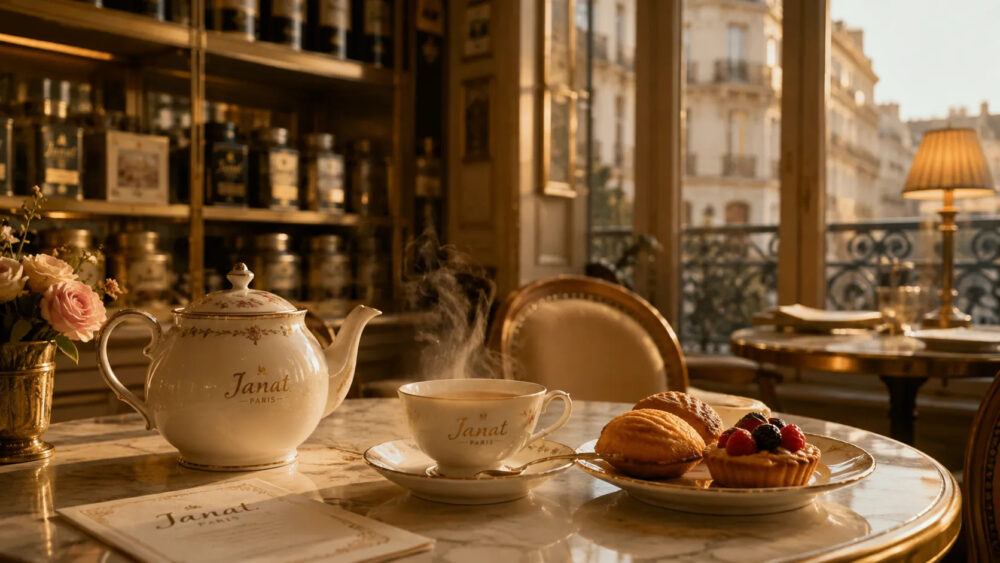
There is a certain hour in Paris when the light turns soft and golden, somewhere between four and five in the afternoon, when the pace of the city seems to slow down just a little. Shop windows glow, chairs are pulled out onto narrow terraces, and inside old tea salons tucked behind courtyards and cobblestone streets, the gentle clink of porcelain begins. This is the hour of tea in Paris. It is not loud. It is not rushed. It is simply there, woven so naturally into daily life that many Parisians barely think of it as a ritual at all. But for those of us who love tea, wherever we are in the world, Paris tells a beautiful story about how a foreign leaf became a deeply loved part of a nation’s identity.
At Janat Tea, we believe tea is a language every culture speaks in its own accent. France speaks it with elegance, patience, and a touch of quiet luxury. This is the story of how that happened, and why it still matters to tea lovers everywhere today.
A Slow Beginning: Tea Arrives in France
Tea’s journey to France was much slower and quieter than its journey to England. While the British East India Company was busy turning tea into a national obsession, tea in France remained, for a very long time, a rare and expensive curiosity kept mostly inside the homes of aristocrats and the court.
Tea first arrived in France in the early seventeenth century, brought by traders and travelers who had discovered it in China and other parts of Asia. At that time, France was far more devoted to coffee and, of course, wine. Tea had to compete with drinks that already had strong cultural roots, and it did not win easily. For decades, tea remained a drink of curiosity rather than a daily habit. Doctors debated whether it was good or bad for health. Nobles sipped it as an exotic novelty, something to serve to impress guests rather than something to enjoy every afternoon.
It was under the reign of King Louis XIV that tea began to gain a little more respect in French high society. The King’s court was fascinated by imported goods from distant lands, and tea, along with silk, porcelain, and spices, became part of that fascination. Trading families began forming connections with merchants sailing to Persia, India, and the Far East, slowly bringing tea leaves back to French shores. It was in this environment, around the mid-1600s, that some of France’s earliest tea trading families began their work, a tradition that would eventually turn into some of the great Parisian tea houses that still exist today.
Even so, tea remained a slow grower in France. It took nearly two more centuries before tea would step out of the palace and into everyday Parisian life.
The Nineteenth Century: When Tea Found Its French Identity
The real turning point for tea in France came in the nineteenth century, a time of massive change in Paris. The city was being rebuilt with wide boulevards, elegant apartment buildings, and grand shopping arcades. Paris was becoming the Paris we recognize today: a city of beauty, fashion, and refined taste. It was during this century, in 1854, that two brothers, Henri and Édouard Mariage, opened a tea trading house in Paris that would go on to shape the entire identity of French tea culture. Henri and Édouard founded the Mariage Frères Tea House after acquiring their ancestral experience through their father, continuing a family tradition of tea trading that had already been passed down for generations.
What makes this story even richer is how far back this family’s connection to tea actually goes. The tea trade in France began to grow in the middle of the seventeenth century, encouraged by King Louis XIV and the French East India Company as they searched distant lands for exotic goods, and it was around 1660 that ancestors of this same trading family began voyaging on the King’s behalf, eventually helping negotiate trade agreements connected to Persia and India. This means that when the Mariage brothers opened their doors in 1854, they were not starting something new. They were continuing a family relationship with tea that had already lasted nearly two hundred years.
The shop they built was not simply a place to buy tea leaves. It became something closer to a temple of tea, a place where the leaves themselves were treated with the same seriousness the French gave to their finest wines and cheeses. The company traded with China and Ceylon and supplied exclusive retailers, delicatessens, tea rooms, and hotels, although for many decades it did not sell directly to the public or run its own tea rooms. Tea, in other words, entered French culture first through the back door of fine hotels and elegant delicatessens, quietly earning its place at the tables of the wealthy and the fashionable before it ever became something ordinary Parisians could walk in and enjoy for themselves.
This is an important detail for tea lovers to understand. Unlike in Britain, where tea became a drink for everyone fairly quickly, in France tea grew up wearing a coat of luxury. It was associated with fine porcelain, delicate pastries, and unhurried afternoons. That association has never really left French tea culture, and it is part of why drinking tea in Paris today still feels like a small act of indulgence, even when the tea itself is simple.
From Trading House to Tea Salon: The Birth of the Parisian Tea Room
For over a century, the great tea trading houses of Paris worked mostly behind the scenes, selling to hotels and shops rather than serving tea themselves. That changed in the second half of the twentieth century, and the story behind this change is one of the most touching in the entire history of French tea.
By the early 1980s, the founding family’s connection to their original tea house had nearly come to an end. The last owner descended from the founding family, Madame Marthe Cottin, headed the company until 1983. Widowed and in her eighties with no heirs, she searched for someone to carry the legacy forward and found two young men who were eager to learn the tea business. One was a Dutchman with a personal connection to tea plantations, and the other was a Thai student with a family background in agriculture. Together, these two outsiders, neither of them French by birth, took the old trading house and transformed it into something entirely new: a proper tea salon where the public could finally sit down, order a pot of tea, and stay as long as they liked.
This is where the modern idea of the Parisian tea salon truly begins. The tea salon that many visitors know today first opened its doors in 1983, at the very same address where the founding family had run their offices more than one hundred and fifty years earlier. Suddenly, tea was not just something bought in tins and taken home. It became an experience, something to be savored slowly, seated at a table, surrounded by dark wood shelves, vintage tea tins, and staff dressed with old-world formality.
Walking into one of these historic salons today still feels like stepping into another century. Visitors find themselves inside a historic shop filled with wooden shelves and large black metal tea containers, with staff dressed smartly in jackets, vests, and bow ties, creating a scene that feels like stepping into a bygone era. For a first-time visitor, it can feel almost intimidating, like walking into a museum rather than a shop. But the atmosphere is part of the charm. It tells you, without a single word, that what you are about to drink deserves your full attention.
Tea as a Craft: The French Obsession with Quality
One thing that sets French tea culture apart from many other tea-drinking nations is the depth of obsession with sourcing and craftsmanship. The French did not simply adopt tea as a drink; they approached it the way they approach wine, cheese, and perfume, treating it as something worthy of expertise, classification, and careful selection.
This philosophy is reflected beautifully in how French tea houses talk about their collections. Each collection is described as rich with more than a thousand teas, blending original compositions with fine harvested teas, the result of continuous and careful work done directly at the source of the plantations. There is also a strong emphasis on ethics and quality over sheer volume, with a clear preference for smaller, carefully cultivated harvests negotiated directly and fairly with growers. This is very much in line with the broader French cultural instinct of favoring quality over mass production, whether in food, wine, or fashion.
It is also worth noting just how wide the range of tea offered in Paris became. The finest tea houses in Paris proudly describe having the largest tea menu in the world, spanning spring Darjeeling, white tea from Scotland, fine Japanese green teas, blue oolong tea from New Zealand, black tea from Ceylon, yellow tea from China, caffeine-free rooibos, fruit infusions, and maté. This incredible variety shows something important about how the French approached tea. Rather than sticking to one tradition or one style, Paris became a meeting point where teas from every corner of the world could be gathered, studied, blended, and reimagined.
This is where the truly French contribution to global tea culture becomes clear: the art of tea blending. French tea houses became famous not just for selling pure, single-origin teas, but for creating original scented and flavored blends, often inspired by literature, travel, and imagination. Blends with names inspired by famous explorers, fictional characters, or romantic notions of far-off lands became a French specialty, adding a layer of storytelling to every cup. A tea was no longer just a drink; it became a small journey, a way to imagine distant lands without ever leaving your chair.
The French Tea Salon Experience
If you have never visited a proper Parisian tea salon, it is worth understanding what makes the experience so distinct from grabbing a tea bag and hot water at home. A visit to a French tea salon is closer to a small ceremony than a quick drink.
Tea is almost always served in a proper pot, generously sized, often with a small hourglass timer to help you brew it just right. The pastries served alongside tea are treated with the same seriousness as the tea itself, delicate cakes, buttery madeleines, and fruit tarts designed to complement rather than overpower the tea’s flavor. Sugar is offered but rarely expected to be needed, since the teas themselves are blended to have their own natural sweetness and complexity.
Service is formal but warm. Staff take real pride in guiding guests toward the right tea, asking about preferences the way a sommelier might ask about wine. And crucially, there is no rush. Tables are not turned over quickly. You are welcome to sit for an hour, two hours, simply enjoying the atmosphere, a book, or quiet conversation with a friend.
This unhurried approach to tea is perhaps the single biggest gift French culture has given to tea lovers worldwide. In a world that often treats tea as something to gulp down quickly before running to the next task, the French tea salon insists on the opposite. It insists that tea deserves your full presence, even if just for twenty minutes in the middle of a busy day.
Beyond Mariage Frères: A Wider World of Parisian Tea
While one historic tea house looms large over the story of French tea, it is important for tea lovers to know that Paris today is home to a wonderfully diverse tea scene. Small independent tea shops have opened across neighborhoods like the Marais, Saint-Germain-des-Prés, and Montmartre, each with its own personality. Some focus purely on rare single-origin teas imported directly from small farms in China, Japan, Taiwan, and India. Others specialize in modern, creative blends aimed at a younger generation of tea drinkers who want something bold and unusual.
Alongside these shops, a new generation of Parisian cafés has begun treating tea with the same seriousness once reserved only for coffee. Just as specialty coffee shops transformed how people think about coffee, specialty tea bars in Paris are now doing the same for tea, focusing on proper brewing temperatures, steeping times, and the origin story behind each leaf.
This growing diversity matters because it shows that French tea culture is not frozen in the past. It continues to grow, welcoming new influences from around the world while still holding onto the deep respect for craft and ritual that has defined it since the nineteenth century.
Why Paris Still Matters to Tea Lovers Everywhere
You might be reading this from a small tea shop in your own city, thousands of miles from Paris, and wondering why this story matters to you. The truth is, Paris offers something valuable to every tea lover, no matter where in the world they live.
First, Paris teaches patience. In a fast-moving world full of instant everything, the Parisian approach to tea is a gentle reminder that some pleasures are meant to be slow. Brewing tea properly, waiting those extra few minutes, and drinking it while it is still warm rather than rushing through it, this is a small act of self-care that anyone, anywhere, can practice.
Second, Paris teaches us that tea can be treated as an art form, not just a beverage. The French willingness to blend, experiment, and tell stories through tea has expanded what tea can be. A cup of tea does not have to be plain. It can carry the scent of vanilla and caramel, the memory of a garden in bloom, or the imagined spice markets of a faraway city. This spirit of creativity has influenced tea makers around the globe, encouraging them to think beyond tradition and explore new flavors and combinations.
Third, and perhaps most importantly, Paris shows us that tea belongs everywhere. It does not matter that tea was not originally a French crop or a French tradition. What matters is that a culture opened its arms to this leaf, studied it with care, and made room for it in daily life. This is exactly what tea lovers around the world are doing in their own countries and communities, whether in a small kitchen in India, a cozy apartment in New York, or a quiet home in the countryside of any nation. Wherever tea is brewed with attention and enjoyed with presence, a small piece of that Parisian spirit lives on.
Bringing a Little Paris Into Your Own Tea Ritual
You do not need a plane ticket to Paris to bring some of this spirit into your own life. Here are a few simple ways any tea lover can borrow from the French approach to tea.
Start by choosing quality over quantity. Rather than buying large amounts of ordinary tea, choose a smaller amount of tea that has been carefully sourced and thoughtfully blended. Pay attention to where it comes from and how it was made.
Slow down the brewing process. Instead of rushing your tea, treat the brewing time as a small pause in your day. Use a proper teapot if you can, and let the tea steep fully before pouring.
Pair your tea with something delicious. The French understand that tea and food are companions. A simple pastry, a piece of fruit, or a light biscuit can turn an ordinary cup of tea into a small, satisfying ritual.
Create a moment, not just a drink. Set aside even ten or fifteen minutes without your phone, without rushing to the next task, and simply enjoy your tea. This, more than any fancy equipment or rare leaf, is the true heart of the French tea tradition.
A Cup That Connects the World
The story of Paris and tea is really a story about how something foreign can become beloved, how patience and care can transform a simple leaf into a cultural treasure, and how a city known for wine and coffee still found room in its heart for tea. From the trading ships of the seventeenth century to the elegant tea salons of today, tea in Paris has always been about more than taste. It has been about beauty, story, and the simple pleasure of slowing down.
At janatea.com, we see this same spirit reflected in tea lovers everywhere, in every country, in every kitchen and living room where a kettle is warming and a cup is waiting. Paris may have given tea its own elegant French accent, but the love of tea itself is a language shared by all of us. Wherever you are reading this, in a bustling city or a quiet countryside home, we hope you will pour yourself a cup, slow down for just a moment, and enjoy a little taste of that same Parisian spirit.
After all, whether it is sipped in a grand Paris tea salon or in your own favorite chair at home, a good cup of tea always tells the same story: one of comfort, connection, and a small, beautiful pause in the middle of a busy world.
Find your next cup.
Need help choosing your tea? Tell us what you enjoy, and our team will help you find your next cup.