
French Oak Tea vs Regular Black Tea: Is It Worth the Price?
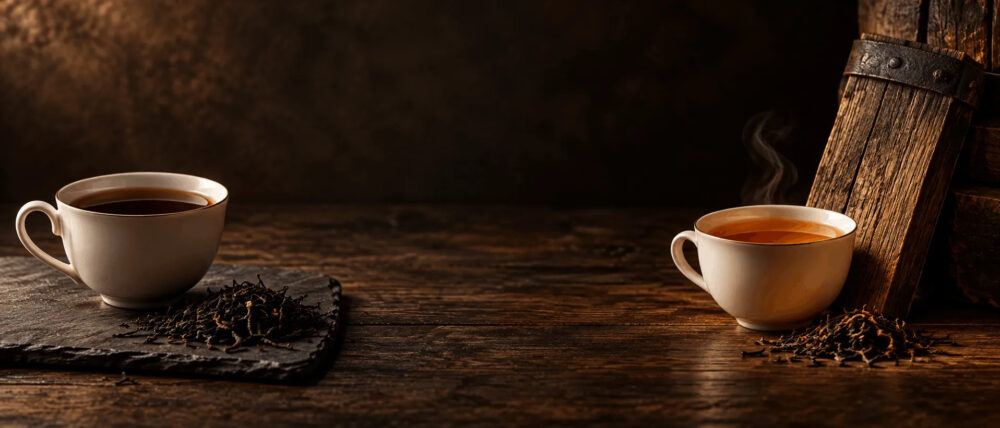
There’s a specific moment every tea shopper hits: you’re looking at two tins side by side, one labeled simply “black tea” and the other “French Oak,” and the second one costs more. Is it genuinely a better cup, or just better marketing? That’s a fair question, and it deserves a real answer instead of a sales pitch — so here’s an honest breakdown of what actually separates the two, and who each one is really for.
What “Regular” Black Tea Actually Is
Most black tea — including good, well-made black tea — follows the same basic path: leaves are plucked, withered, rolled, oxidized, and dried. That’s it. The quality differences you taste between one black tea and another come down to where the leaves were grown, how they were plucked (whole leaf vs. broken vs. dust), and how carefully the oxidation was controlled. A well-made Ceylon or Assam black tea can be genuinely excellent — brisk, malty, reliable with or without milk. There’s nothing “lesser” about a classic black tea; it’s simply a shorter, more direct process, and the price reflects that.
What Makes French Oak Tea Different
French Oak Tea isn’t a flavoring added after the fact — it’s an entirely different process. The tea is aged inside oak barrels, a technique more commonly associated with wine and whisky than tea, which is exactly why JANAT calls Original French Oak the world’s first tea brewed this way. During that time in the barrel, the tea leaves slowly pick up trace notes of oak wood and a soft vanilla character from the wood itself, rather than from any added flavoring.
That barrel-aging step is the entire reason for the price gap. It takes longer, it requires actual oak barrels (which cost money to source and maintain), and it produces a smaller, more deliberate batch than a standard black tea run. You’re not paying extra for a fancier label — you’re paying for an additional stage of production that a regular black tea never goes through.
Taste Test: What You’re Actually Paying For
Here’s where it gets specific. A regular black tea gives you a clean, direct flavor: whatever the tea leaf itself tastes like, shaped by where it grew. French Oak tea gives you that same tea character, but with a second layer underneath it — a subtle woodiness and a gentle vanilla warmth that lingers after the sip, similar to how a barrel-aged spirit tastes different from an unaged one.
It’s a genuinely different drinking experience, not just a “smoother” or “stronger” version of the same thing. If you’ve ever tasted the difference between an unaged and a barrel-aged spirit, that’s the closest comparison — the base is similar, but the finish tells you something extra happened.
So — Is It Worth the Price Difference?
Honestly, it depends on what you’re drinking tea for.
Regular black tea is worth it if:
- You drink tea multiple times a day and want something reliable for everyday use
- You take milk and sugar and want a tea that holds up to that
- You’re stocking up for a household or an office where cost-per-cup matters
- You just want a good, honest cup without needing it to be an “experience”
French Oak tea is worth it if:
- You want a tea that feels like a moment, not just a habit — a slower afternoon, a quiet evening
- You’re buying a gift for someone who already has “the basics” covered
- You’re curious about tea as a craft, the same way some people get curious about specialty coffee or aged spirits
- You want something to serve when you’re actually trying to impress a guest, not just get through your 3pm slump
Neither one is the “wrong” choice. A daily black tea and an occasional French Oak tea aren’t competitors — they’re suited to different moments in the same day.
A Simple Way to Decide
If you’re still unsure, ask yourself one question: am I buying this to drink often, or to enjoy slowly?
If the answer is “often,” a quality black tea gives you excellent everyday value. If the answer is “slowly,” the extra cost of French Oak tea buys you a barrel-aging process no regular black tea goes through — and a flavor you genuinely can’t get any other way.
Try Original French Oak →
Shop the Black Series →
Not ready to choose between them? You don’t have to — many tea drinkers keep both in rotation: a dependable black tea for daily use, and French Oak for the moments worth slowing down for.
FAQ
Is French Oak tea flavored artificially?
No — the oak and vanilla notes come from the barrel-aging process itself, not from added flavoring, which is part of why it’s produced in smaller batches than regular black tea.
Does French Oak tea taste smoky, like a smoked tea?
No. The character is closer to a soft vanilla-and-wood warmth than smokiness — subtler and closer to how oak aging affects wine or whisky.
Can I drink French Oak tea with milk?
You can, but most people drink it without milk to let the oak and vanilla notes come through clearly — milk tends to mute the subtler flavor layer that makes it different from regular black tea.
Is French Oak tea caffeinated?
Yes, since it’s made from black tea leaves — the barrel-aging process affects flavor, not caffeine content.
Find your next cup.
Need help choosing your tea? Tell us what you enjoy, and our team will help you find your next cup.