
Moroccan Mint Tea: How to Make It the Traditional Way
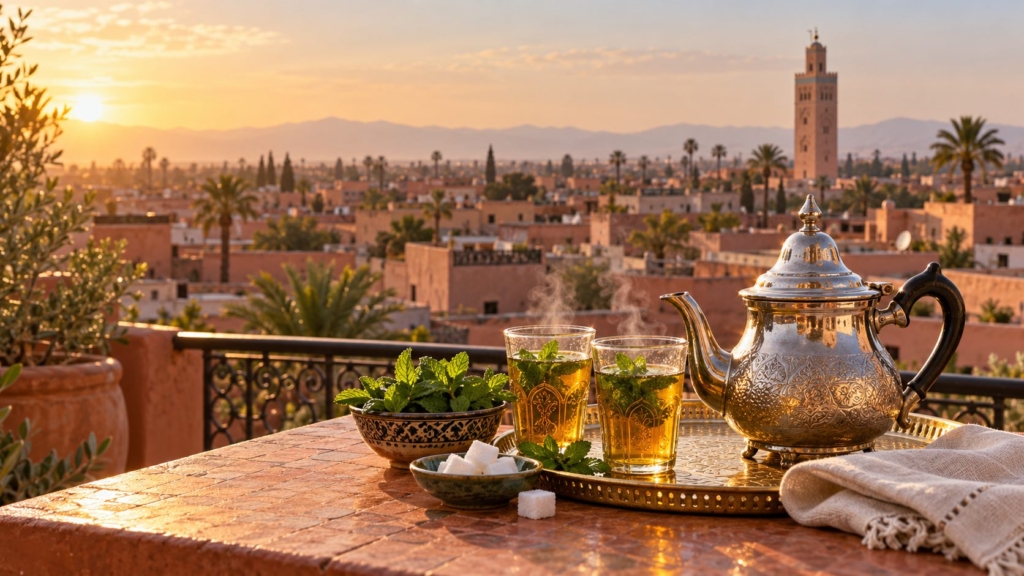
Fresh spearmint meets hot tea, and a cool, sweet smell rises from the pot. Then comes the pour: a thin amber stream into small glasses, each capped with a little foam.
It is a drink made for sharing, and easier to make at home than it looks. Below you’ll find one traditional method with exact quantities, what each ingredient does, why the tea is poured from a height, and fixes for a bitter or flat pot.
What is Moroccan mint tea?
Moroccan mint tea is a sweet, hot drink made by brewing Chinese gunpowder green tea with a generous handful of fresh spearmint and sugar, usually in a metal teapot. It is poured into small glasses and widely offered to guests. Because it contains green tea, it is not caffeine-free.
That makes it different from a mint-only herbal infusion. Moroccan mint tea, known as atay in Morocco, is built on real tea from the Camellia sinensis plant.
Preparation varies between households and regions. The recipe below is one well-documented traditional method, not the only authentic one.
Gunpowder tea reached North Africa through British trade in the 18th and 19th centuries, and mint tea was well established in Morocco by the early 20th century. Accounts of how the custom began differ. (Wikipedia: Maghrebi mint tea)
The ingredients, and why each one matters
Gunpowder green tea
Gunpowder is a Chinese green tea rolled into small, tight pellets. It gives the drink body, colour and a gentle bitterness for the mint and sugar to balance. Gunpowder or Chun Mee are the teas commonly named for this drink.
Look for dark grey-green pellets of fairly even size, without much dust. Dust brews bitter quickly.
Substitute: another robust Chinese green tea works. A delicate Japanese green tea such as sencha will not handle the boiling step well and will taste harsh.
Fresh spearmint
Spearmint (Mentha spicata), called na’na in Moroccan Arabic, is the mint traditionally used. It smells sweet and green, with a soft coolness.
Peppermint has more menthol and tastes sharper and colder. If it’s all you have, use about half the amount and expect a different flavour.
Sugar
Sugar is part of the traditional recipe. It balances the tea’s bitterness and rounds out the mint. Many households sweeten generously, but amounts vary widely, so treat any figure as a starting point.
White granulated sugar dissolves cleanly. In Morocco, sugar is also commonly bought as cones or blocks.
Water
Use fresh water that tastes good on its own. If your tap water is very hard or smells of chlorine, filtered water gives a cleaner cup.
Equipment you need
A Moroccan teapot (berrad). A rounded metal pot with a long, narrow spout for a controlled pour, often with a built-in strainer.
Small heatproof glasses made for hot drinks, plus a kettle.
No Moroccan teapot? Use a small stainless-steel saucepan for the heating step, then pour through a fine strainer into a jug or heatproof teapot for serving.
Safety: only put a pot over direct heat if it is designed for stovetop use. Ceramic, glass and many decorative teapots can crack. Hold the hot metal pot with a folded cloth.
Traditional Moroccan mint tea recipe
- Yield: about 450 ml, four small servings of roughly 110 ml each
- Preparation time: 5 minutes
- Cooking time: 10 minutes
- Total time: 15 minutes
Ingredients
- 6 g gunpowder green tea (about 2 level teaspoons)
- 15 g fresh spearmint (about 8 to 10 sprigs)
- 30 g white granulated sugar (about 2½ tablespoons). Adjustment range: 15 to 45 g (about 1¼ to 3½ tablespoons)
- 700 ml water, boiled and used in stages (about 100 ml to warm the pot, 100 ml to rinse, 100 ml for the first infusion, 400 ml to fill)
How the first two pours work
Two short pours come before the main brew, with different jobs.
- The rinse is discarded. It washes dust off the leaves and starts to open them. It looks pale and a little cloudy.
- The first infusion is kept. Often called the “spirit” of the tea, it is clear and amber, and it goes back into the pot.
Some households reserve first, then rinse. Either way, keep one pour and discard one.
Rinsing does not make the tea caffeine-free. A 30-second hot rinse removes only a small share of the caffeine, roughly 9% in one study.
Instructions
- Wash the mint. Swish the sprigs in a bowl of cold water, lift them out and shake dry. Remove thick lower stems and damaged leaves.
- Boil the water and warm the pot. Bring the 700 ml of water to a boil. Pour about 100 ml into the teapot, swirl it, and discard it.
- Add the tea. Put the 6 g of gunpowder tea into the warm pot.
- Rinse the leaves (discard). Pour in about 100 ml of boiling water, swirl for about 10 seconds, and pour it away. Expect it to look cloudy.
- Make the first infusion (keep). Pour in another 100 ml of boiling water. Leave it undisturbed for 1 minute, then pour it into a glass and set it aside. It should be clear amber and smell of green tea.
- Return the infusion and fill the pot. Pour the reserved infusion back in, then add the remaining 400 ml of boiling water. Set the stovetop-safe pot over low to medium heat with the lid open.
- Add the mint, then the sugar. When small bubbles appear on the surface, after about 1 to 2 minutes, add the mint and press it under with a spoon. Add the sugar.
- Bring it briefly to the boil. Watch the pot. The mint rises first, then the tea leaves start to lift and unfurl, usually within 2 to 3 minutes. Take the pot off the heat as soon as it boils. Don’t stir.
- Mix by pouring. Pour a glass of tea and return it to the pot. Repeat 2 or 3 times to blend without stirring up the leaves.
- Taste and serve. Taste a little. It should be sweet, fresh and minty, with a clear tea backbone. Add sugar if needed and mix again by pouring. Pour into four glasses, about 110 ml each.
Why boil a green tea?
Delicate green teas are brewed below boiling, but tightly rolled gunpowder leaves need strong heat to open, and a brief boil builds the body that stands up to mint and sugar. Keep it short: long boiling turns it harsh.
Without a stovetop pot: after step 7, cover the pot and steep off the heat for 4 to 5 minutes. This is an adaptation. The tea will be lighter in body, but still good.
Why is Moroccan mint tea poured from a height?
Pouring from a height aerates the tea and creates the light foam on top of each glass.
You don’t need a dramatic pour. Start with the spout close to the rim. Once the stream is steady, lift slowly by a few centimetres, then lower again before stopping. Practise over a tray, with glasses on a stable surface.
How to adjust the sweetness and strength
- Stronger tea: use 7 to 8 g of leaves, or let the pot sit off the heat for 1 to 2 minutes before pouring.
- Milder tea: use 4 to 5 g of leaves and take the pot off the heat the moment it boils.
- More mint: add a few extra sprigs at step 7. Push them under so they release aroma rather than floating.
- Sweetness: start at 30 g and taste. Go up towards 45 g for a sweeter style, closer to many traditional households, or down towards 15 g for a lighter one.
No single sugar level defines authenticity; sweetness is a household choice.
Reduced-sugar and unsweetened versions are adaptations. For Moroccan mint tea without sugar, use 4 to 5 g of tea, keep the boil very short and add a few extra mint sprigs; bitterness shows more without sugar.
Common mistakes and how to fix them
| Problem | Likely cause | Practical adjustment |
|---|---|---|
| Too bitter | Too much tea, long boiling, or tea dust | Use less leaf, remove from heat as soon as it boils, choose whole pellets. Sugar can balance how bitter it tastes, but won’t remove the cause |
| Weak, watery flavour | Too little tea, or the leaves never opened | Use 7 to 8 g, and make sure the pot reaches a brief boil |
| Overpowering mint or menthol | Peppermint instead of spearmint, or too much | Use spearmint, or halve the quantity of peppermint |
| Grainy or uneven sweetness | Sugar not fully dissolved | Add sugar while the pot is hot, and mix by pouring 2 or 3 times |
| Tea and mint out of balance | Leaf and mint quantities not matched | Start with the recipe ratio of 6 g tea to 15 g mint, then adjust one at a time |
Serving Moroccan mint tea
In Morocco, tea is commonly offered to guests as a sign of hospitality and is drunk throughout the day. Customs differ between families and regions, so there is no single correct ritual.
Some households serve several rounds from one pot, the flavour deepening as the leaves steep. A well-known saying compares the three glasses to life, love and death; it is a saying, not a rule.
Some cooks add herbs such as lemon verbena or wormwood alongside the mint, and the tea is enjoyed with nuts, biscuits, cakes, meals or on its own. For an easy spread at home, almonds, dates and simple butter biscuits all work well; that is an editorial suggestion, not a fixed tradition.
Make it your own
Your first pot may be a little strong or a little sweet. Make it a few times, change one thing at a time, and you’ll learn how your tea, mint and stove behave.
Curious how other green teas want to be brewed? Our Japanese sencha guide explains why delicate leaves need cooler water than this recipe uses. You can also explore the JANAT tea collections to find your next everyday cup.
Frequently asked questions
Which tea is used in traditional Moroccan mint tea?
Chinese gunpowder green tea is the usual base. Its tightly rolled pellets hold up to brief boiling and give the body and gentle bitterness that balance the mint and sugar. Chun Mee, another Chinese green tea, is also used. Delicate Japanese green teas are not a good match, because they turn harsh at high heat.
Is spearmint or peppermint better for Moroccan mint tea?
Spearmint is the traditional choice. It is sweeter and softer, so the tea still comes through. Peppermint has more menthol, which tastes sharper and can dominate the glass. If you only have peppermint, use about half the quantity and taste before adding more.
Does Moroccan mint tea contain caffeine?
Yes. It is made with green tea, which naturally contains caffeine. The rinse in this recipe cleans and opens the leaves but removes only a small share of the caffeine. If you want a caffeine-free mint drink, steep mint on its own; that makes a herbal infusion, which is a different drink.
Can you make Moroccan mint tea without sugar?
Yes, as an adaptation. Unsweetened Moroccan mint tea tastes more bitter and more herbal than the traditional version. To keep it pleasant, use 4 to 5 g of tea, keep the boil very short and add a few extra mint sprigs. Some people find a small amount of sugar a good middle ground.
Why does my Moroccan mint tea taste bitter?
The usual causes are too much tea, boiling for too long or using dusty, broken leaves. Take the pot off the heat as soon as it boils, use whole gunpowder pellets and try 4 to 5 g of leaves. Sugar can soften how bitter the tea seems, but it doesn’t remove the cause.
Do you need a Moroccan teapot to make it?
No. A Moroccan teapot makes heating and pouring easier, but a small stainless-steel saucepan and a fine strainer work well. Heat the tea in the saucepan, then strain it into a jug or heatproof teapot. Never put a ceramic, glass or decorative teapot over direct heat unless it is designed for stovetop use.
Find your next cup.
Need help choosing your tea? Tell us what you enjoy, and our team will help you find your next cup.